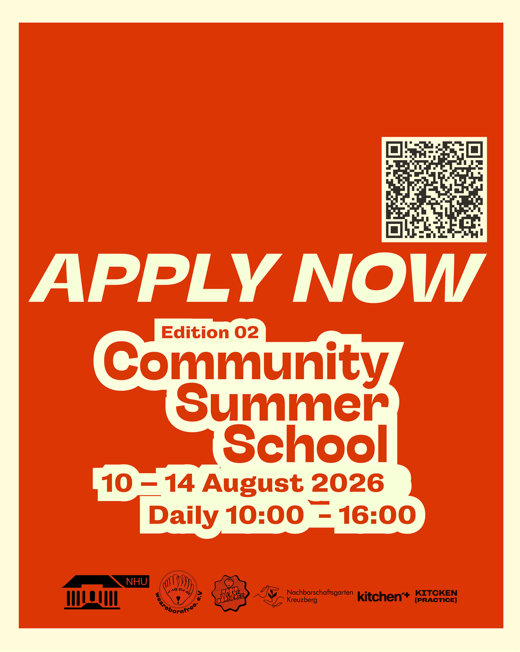
Open Call: Community Summer School 2026
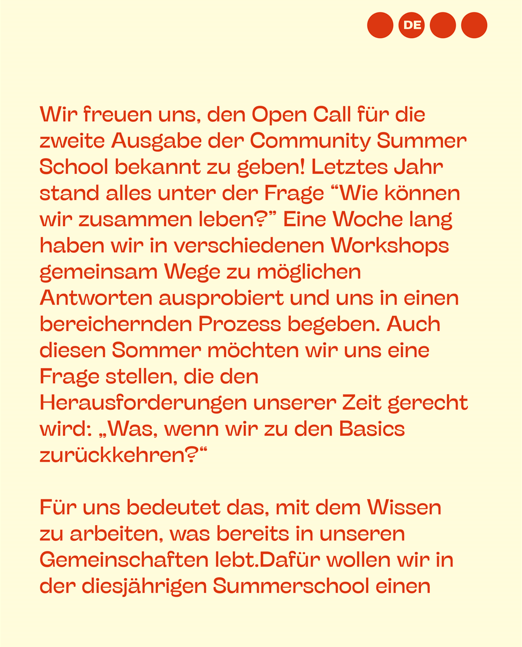
Wir freuen uns, den Open Call für die zweite Ausgabe der Community Summer School bekannt zu geben!
Letztes Jahr stand alles unter der Frage
“Wie können wir zusammen leben?”
Eine Woche lang haben wir in verschiedenen Workshops gemeinsam Wege zu möglichen Antworten ausprobiert und uns in einen bereichernden Prozess begeben.
Auch diesen Sommer möchten wir uns eine Frage stellen, die den Herausforderungen unserer Zeit gerecht wird:
„Was, wenn wir zu den Basics zurückkehren?“
Ausgabe 02
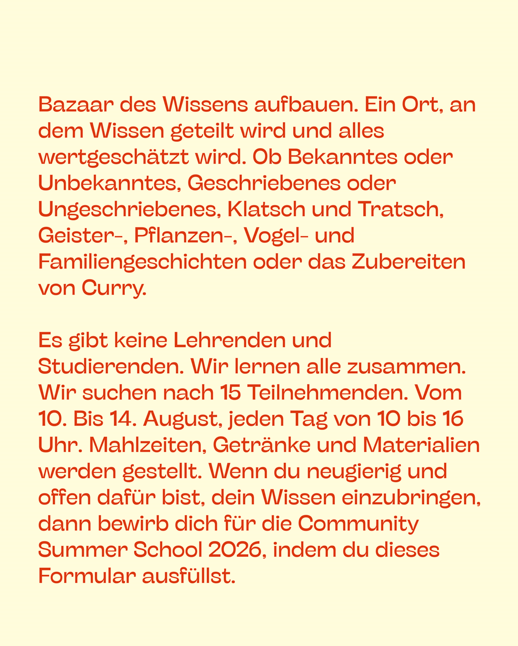
10. – 14. August : 10 – 16 Uhr
15 Teilnehmende im Nachbarschaftsgarten Kreuzberg
The School is the Neighborhood — Summer School 2026
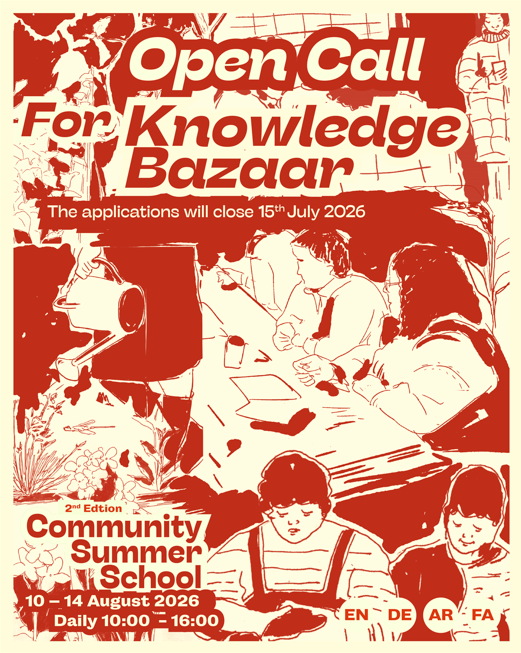
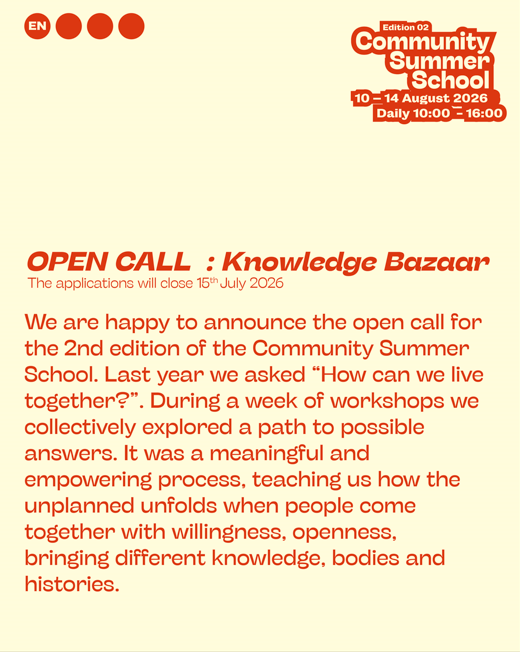
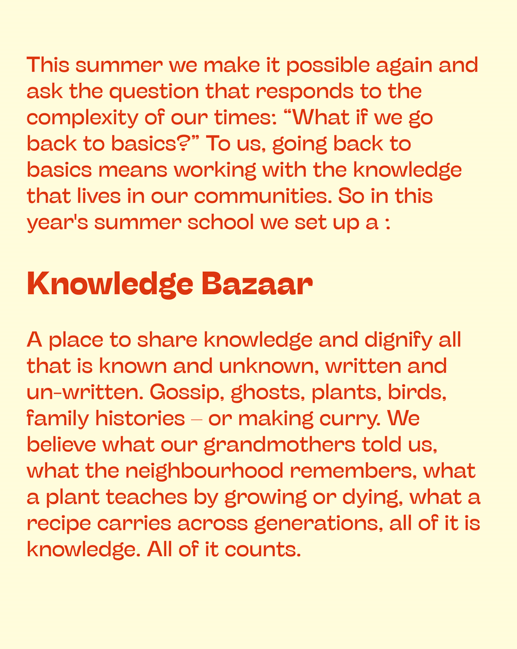
Last year we asked: how would we like to live together?
This year we want to explore the answer.
We are flipping the model.
Not a school with a curriculum, but a school that builds itself. Not teachers and students, but a group of people who arrive with what they know and leave with what they didn’t expect.
The summer school becomes a site of production,of knowledge, of encounter, of questions we haven’t yet asked.
The format changes: The responsibility is shared. Participants are not recipients of a programme they are co-producers of it. Everyone arrives with a skill, a curiosity, a provocation. Everyone puts something on the table.
We are building a knowledge bazaar: a week-long, self-organised platform where sessions are in conversation with one another, where the open call already asks what do you want to learn. The application is the first act of the school.
The structure is porous. Shared meals, open doors, strangers welcome. Inclusivity and Playfulness is not a bonus it is our method.
The neighborhood is part of the curriculum.
There is no diploma at the end. Or rather you receive it on the first day, and spend the week deciding what it means.
Overview: (more details below)
Day 1: Building the school together: Build a table, the knowledge board, a folder. Receiving a diploma.
Day 2-4:Knowledge bazaar: Participants map what they bring and what they’re looking to learn. A „skills board“: A living, visual menu of offerings that updates daily as new exchanges emerge.
Day 5: A finissage that reflects the process, not just the output: Showing how the school was made, not only what we made.
The Open Call
The idea of co-owning the school weaves through all aspects.
Instead of: „We are offering X. Apply if you’re interested.“
The call becomes: „We are building a school…What do you know well (that others might not)?
What do you know by heart?
What do you want to learn that you can’t learn alone?
What would you be willing to teach, share or try — even if you’re not an expert?
The organising team reads the applications to map the knowledge landscape of the group and identify what conversations are already wanting to happen.
Open Call text:
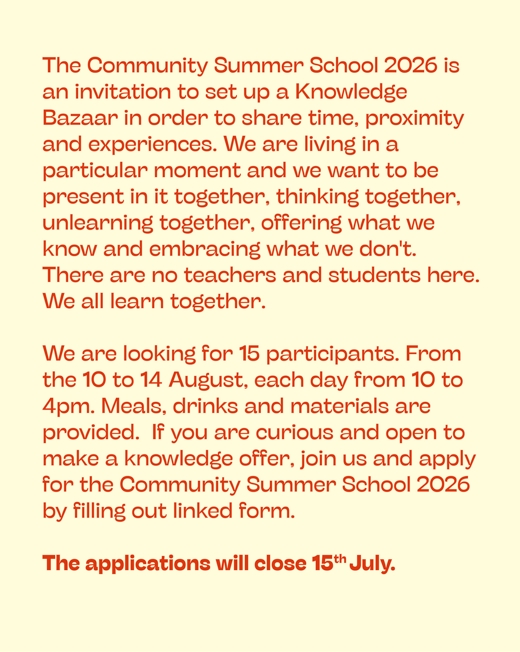
We’re not bringing a programme this summer. We’re bringing a table.
Tell us what you know. Tell us what you want to learn. Come build the school with us. Five days in Kreuzberg.
This summer we are gathering again: five days, open skies, shared meals. But this year we are not bringing a programme. We are bringing a table. You bring the rest.The Community Summer School is a self-organised space for learning together.
The pillars of the school
The Hosts:
Someone has to set the table. Someone has to make sure there is food, that the space is open, that the week holds together. But hosting is not leading. The organising team ensures the conditions — and then joins the school as participants like everyone else. We are not here to teach. We are here to make learning possible, and then to learn alongside you. School works when we make ourselves unnecessary.
The Kitchen:
Shared meals, food and food making are an intrinsic part of the school.Shared meals, collective cooking, and the rituals around eating are woven into every day of the school. The kitchen is where conversations begin and where they continue long after the session ends.We believe that learning happens at the table as much as anywhere else.(how about food experiments become part of the school to activate the senses: e.g. one day one color of food, or crunchy food and plugged ears – concert in your head,or combination of specific tastes etc.)
Building the School:
The school does not arrive pre-assembled. On the first day, we build it. The table, the knowledge board, the week’s sessions. Everything is made together. It is the school’s first and most important statement: that this space belongs to everyone in it, and that co-ownership begins before anything else.
The Knowledge Bazaar:
Everyone arrives with something to offer. Everyone arrives curious for something. The knowledge bazaar is the center of the school — a board, a map, a shifting collection of skills, questions, practices and curiosities that the group assembles and updates throughout the week. Sessions emerge from it. Unexpected conversations grow out of it. It makes visible what is already in the room and asks: what can we make with this?
The Finissage:
as Reflection and Invitation The school ends with a finissage, but not a showcase of finished work. It is a reflection on the process itself. What did we build? What questions are still open? Who is not here yet? The finissage faces outward — into the neighbourhood, toward the people who didn’t come this time. It is less a conclusion than an open door.
No Students: We don’t have students. We have neighbours, members, partakers, participants, co-hosts. We have people who show up with something and leave with something else. The word student implies a receiver
| Day 01: The collective act of school building The first day is the first act of the school itself. Nothing is pre-arranged. The space is empty. The school gets built together. The Table The day begins with building a communal table. Materials are provided but assembly is collective and unscripted. The table becomes the school’s center for the whole week, where meals happen, where debates happen, where the knowledge board lives. The Knowledge Board We are building a physical board. Each person answers two questions and pins them up: What do I bring? What do I know by heart? (a skill, a practice, a question, a obsession) What am I looking for? (something I want to learn, encounter, be challenged by) The board becomes the overview of material from which the week’s sessions are built collectively. The School Folder Each participant makes their own school folder. It is their notebook, their archive, their diploma. It travels with them through the week and becomes part of the finissage. The First Meal The day closes with a shared meal that the group also prepares together. Cooking as the final act of building and the first act of being a school. |
| Day 02/03/04: Knowledge Bazaar / Active Knowledge Creation Process of creating the sessions to be defined Sessions can take any form: a workshop, a walk, a conversation, a making, a reading, a demonstration, a failure. The only condition is that whoever proposes a session also holds it not as an expert, but as someone with something to share. Each afternoon closes with a short collective reflection: what happened today, what it opened up, what wants to continue tomorrow. |
| Day 05: Finissage To be defined The final day belongs to the neighborhood. The school opens its doors. Participants share not finished works but the process — the board, the folders, the traces of the week. The finissage is an invitation: to the people who were here, to come back. To the people who weren’t, to come next time. |
Why We Gather
Back to basics does not propose a return to simplicity. It proposes a return to the conditions under which knowledge has always, at its best, been produced — collectively, bodily, with consequence. It situates itself inside the contradictions of the present, not outside them.
The community garden is not a setting. It is a spatial argument. Knowledge produced here belongs to those who produce it.
This is the curriculum: not a timetable but a mise en place. Not modules but courses. Not a syllabus but a menu. Not outcomes but a shared meal, eaten outside, in a garden, around a kitchen we built ourselves.
Our Principles
It is a school where everyone is an expert, a school of shared experiences
It is not a classroom, but a commons
It is not about answers, but about learning collectively and asking differently
The school is socially engaged
We focus on process over perfection
We believe in the necessity of practicing community
We are rooted in the neighborhood
We create space for togetherness, curiosity and encounter
Key words:
Multiple voices
Self organised knowledge creation
There is no strict curriculum so much as a certain set of issues we aim to address (theoretical, practical, developmental), resources we hope to provide (literature, ideas,knowledge, perspectives) and open outcomes
Summerschool becomes a site of production, a site of active knowledge creation.
The school is in the neighborhood.
The participants are co-producing the school.
Open door policy: If strangers walk in we welcome them but ask them to introduce themselves.
Gefördert durch
www.kiezaktivkasse.de